Leave Your Message
Choosing an On Grid Inverter is not just a matter of matching its wattage to your solar panels. The right choice affects energy yield, system reliability, monitoring, and how smoothly your installation works with the local grid. IRENA’s Renewable Capacity Statistics 2024 reports that global solar capacity grew by about 345.5 GW in 2023. That rapid expansion makes careful equipment selection more important, not less. Bigger is not automatically better.
NREL researcher Dr. Andy Hoke’s grid-integration work points to a useful principle: assess an inverter by how it interacts with the grid, not only by its nameplate rating. For a rooftop system, compare the inverter’s continuous AC output with the panel array’s DC capacity, then check its MPPT range, phase compatibility, operating voltage, efficiency, monitoring, and warranty. A shaded roof may benefit from different design choices than a clear, south-facing array. Small details matter.
A label can look reassuring. It is not the whole story. Check the product documentation and ask an installer to explain expected clipping, temperature performance, and service support. IRENA’s capacity figures describe the market, not the quality of any one product, so they cannot identify a winner for your roof. Real conditions vary. This guide will help you compare the specifications that matter and spot trade-offs before you buy. One useful reminder: even a strong inverter can disappoint when it is poorly matched to the array or site.
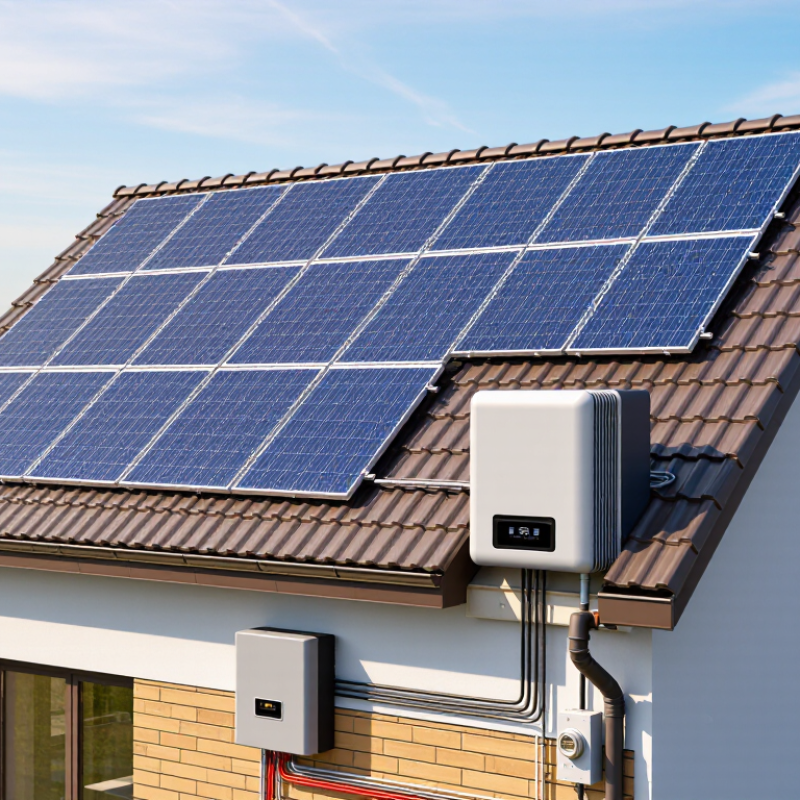
An on-grid inverter connects a solar array to the utility network. Panels produce direct-current electricity; household circuits use alternating current. The inverter converts that power and synchronizes its voltage and frequency with the grid. It also tracks the panels’ maximum-power point, helping them produce effectively as sunlight changes. A small cloud can shift output quickly.
It does more than convert electricity. Grid protection can stop the inverter from feeding power into a disconnected line, while monitoring can reveal faults or poor performance. The IEA PVPS Snapshot of Global PV Markets 2024 reports that roughly 447 GW of solar capacity was added worldwide in 2023, bringing cumulative capacity above 1.6 TW. That growth makes inverter performance a practical system concern, not just a specification-sheet detail. When choosing one, compare its input-voltage range with the array design, check output capacity and operating-temperature limits, and confirm that its grid-support functions suit the installation. A common mistake is to focus only on rated power. I’d also examine monitoring quality and service access; these details are easy to overlook, and datasheets rarely tell the whole story.
| Selection Dimension | What to Check | Practical Guidance | Why It Matters |
|---|---|---|---|
| PV array capacity | Maximum recommended PV input power and permitted DC-to-AC ratio | Compare the solar array’s rated DC capacity with the inverter’s AC output rating. A DC-to-AC ratio around 1.1–1.3 is common in many designs, but the suitable value depends on climate, orientation, shading, utility rules, and inverter limits. | An array that is too large can exceed input limits or cause more output clipping; an undersized array may leave inverter capacity underused. |
| Grid connection and phase | Single-phase or three-phase output, nominal voltage, frequency, and approved grid profile | Match the inverter to the property’s electrical service and the local utility’s connection requirements. Confirm the exact voltage and frequency rather than relying on a general regional assumption. | An inverter must be electrically compatible with the site and permitted to operate on the local grid. |
| MPPT inputs | Number of independent maximum power point trackers (MPPTs) and input-current limits | Use separate MPPTs for groups of panels with different orientations or significantly different shading. Check that each string’s operating current stays within its tracker’s limit. | MPPTs help the inverter optimize panel output; mismatched strings on one tracker can reduce energy production. |
| String voltage range | Maximum DC voltage, MPPT operating range, and start-up voltage | Calculate string voltage at the site’s expected temperature extremes. Keep the cold-weather open-circuit voltage below the inverter’s maximum DC voltage and ensure the operating voltage falls within its MPPT range. | Incorrect string sizing can prevent reliable operation or exceed a safety-critical equipment limit. |
| Conversion efficiency | Maximum and weighted efficiency, measured under a stated test method | Compare weighted efficiency figures where available, not just peak efficiency. Also consider expected operating conditions and whether the figures are reported on a consistent basis. | Efficiency affects how much DC energy is converted into usable AC energy, especially across different load levels. |
| Grid protection and certification | Anti-islanding protection, grid-support functions, and locally required certifications | Verify current approvals and settings required by the utility or electrical authority in the installation location. Requirements vary by jurisdiction. | Grid-tied inverters must disconnect or respond appropriately when grid conditions are outside permitted limits, helping protect workers and the electrical system. |
| Monitoring and communications | Energy monitoring, fault alerts, data access, and available communication options | Check whether monitoring is available locally or through a network connection, and confirm that the communication method works at the installation site. | Monitoring can help identify faults, compare production with expectations, and support maintenance. |
| Environmental rating | Operating temperature range, enclosure rating, ventilation needs, and installation location | Choose an enclosure and location suitable for expected weather and exposure. Follow the manufacturer’s clearances and avoid locations that trap excessive heat. | Temperature, moisture, dust, and inadequate ventilation can affect performance and equipment life. |
| Warranty and serviceability | Warranty duration, service process, replacement availability, and local technical support | Review the written warranty terms, including exclusions and required installation conditions. Confirm that qualified service is available in the area. | Support and repair access can influence long-term operating costs and downtime. |
| System role and backup needs | Whether the design is grid-tied only or requires backup power during an outage | A standard grid-following on-grid inverter normally shuts down during a grid outage for safety. Backup operation requires compatible equipment and a system specifically designed and approved for that function. | Being connected to the grid does not automatically mean a solar system can supply power during an outage. |