Leave Your Message
In 2026, choosing Batteries For Photovoltaic systems means matching storage to real household or site conditions. A battery that looks impressive on a product sheet may still disappoint beside a cloudy-week forecast or a high evening load. Start with daily energy use, peak power, and the hours you need backup. Then compare usable capacity, round-trip efficiency, cycle life, warranty terms, and compatibility with your inverter. Small details matter.
Battery scientist Dr. Shirley Meng’s research offers a useful principle, paraphrased here: cell chemistry and operating conditions should be considered together. For a photovoltaic system, that means checking how the battery performs across expected temperatures and charging patterns. Lithium iron phosphate may suit many stationary systems, but no chemistry is automatically best for every project. Installation space, expansion plans, maintenance access, and the manufacturer’s degradation guarantee also deserve attention. Look beyond the headline capacity.
A practical choice balances resilience, cost, and lifespan—not just the lowest price per kilowatt-hour. Compare total usable energy with your actual evening demand, and ask how much capacity remains after years of cycling. Review safety documentation and confirm that the battery, inverter, and monitoring system work as a tested combination. A spreadsheet helps. It will not predict every outage or usage change, though. Leave room for uncertainty, and revisit your assumptions before committing.
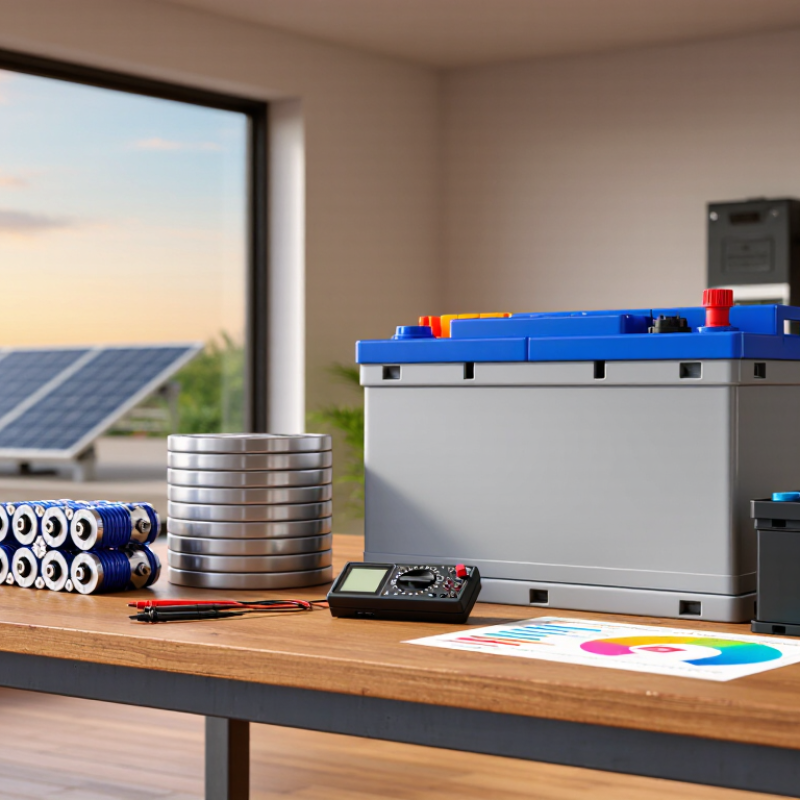
In a photovoltaic system, a battery stores surplus solar electricity for use after sunlight fades. It can increase self-consumption, reduce evening grid purchases, or provide backup during an outage. These roles are different, and one battery may not serve them equally well. A household seeking backup needs enough usable energy for chosen essential loads, such as a refrigerator, lights, and a router. It also needs adequate power to start appliances, not just enough capacity to run them over time. That distinction is easy to miss.
For daily energy shifting, compare the battery’s usable capacity with the home’s evening demand and the system’s typical solar surplus. Check the inverter’s compatibility, charge and discharge limits, operating temperature, and stated cycle life. A battery cannot compensate for undersized solar panels or poor load planning. In practice, sizing is messier than a spreadsheet suggests: cloudy days, seasonal changes, and household habits all affect results. Backup needs may also change. Keep a margin rather than designing around a perfect day, and confirm how much energy remains available when backup reserve settings are enabled. The right role should guide the choice before capacity does.
| Battery Role | What It Does | How to Size It | Important Battery Requirements | Key Checks Before Choosing |
|---|---|---|---|---|
| Solar self-consumption | Stores surplus daytime PV generation for use in the evening or at other low-solar periods. | Compare typical midday surplus with the energy usually used after sunset. Size for the energy that can realistically be charged and discharged, rather than PV array capacity alone. | Usable capacity should match the regular shift in energy use. Charge and discharge power should accommodate household demand and available PV output. | Check seasonal solar variation, household load patterns, battery usable capacity, inverter compatibility, and the system’s round-trip efficiency. |
| Critical-load backup | Keeps selected essential circuits operating during a grid outage, such as refrigeration, lighting, communications, or selected medical equipment. | Estimate each critical load’s energy use over the intended backup period. For example, a 1 kW load running for 4 hours uses 4 kWh before conversion losses and battery reserve are considered. | Confirm both usable energy and continuous output power. The inverter and battery must support the combined loads that may run at the same time. | Check backup circuit selection, transfer time, inverter operating mode, reserve settings, and whether the PV system can recharge the battery during an outage. |
| Whole-home backup | Supplies a broader range of household loads during outages, potentially including larger appliances. | Use measured or carefully estimated outage-period energy demand. Separately calculate peak simultaneous power and motor-starting surges. | Requires sufficient continuous power, surge capability, usable capacity, and compatible backup equipment. Higher-power loads may need to be managed or excluded. | Verify single-phase or three-phase compatibility, starting-current limits, load management, and whether large loads such as electric heating or vehicle charging are supported. |
| Off-grid supply | Stores PV energy to serve loads when solar generation is low or unavailable, often alongside a generator or other backup source. | Base capacity on daily energy use, desired autonomy, and the site’s lowest-solar period. Include conversion losses and avoid assuming that average annual solar production represents winter conditions. | Consider usable capacity, permitted depth of discharge, charge acceptance, continuous output, cycle life, and operation across the site’s temperature range. | Model worst-month generation, consecutive low-sun days, generator charging, load growth, and battery protection settings. |
| Time-of-use shifting | Charges when electricity or solar energy is less valuable and discharges during higher-cost periods, subject to the applicable tariff. | Compare the energy needed during the target peak-price window with the energy available to charge the battery beforehand. | Round-trip efficiency, usable capacity, charge and discharge power, and control scheduling affect how much energy can be shifted. | Check tariff time windows, export compensation, charging rules, demand charges, and whether expected bill savings exceed system costs. |
| PV output smoothing | Can reduce short-term changes in power delivered to a site or grid when PV output varies quickly. | Size for the required power response and the duration of the fluctuations the system is designed to manage. | Fast control response, adequate charge and discharge power, and integration with the inverter or energy management system are important. | Confirm the required control behavior, connection limits, operating reserve, and whether the battery can still meet its other duties. |
| Grid services or demand management | May provide services such as peak-demand reduction or grid support when allowed by the utility, market, and system controls. | Follow the specific program’s power, energy, availability, and dispatch requirements; these vary by location and service. | Usable capacity must account for any energy reserved for the service as well as the site’s own backup or self-consumption needs. | Check program eligibility, interconnection rules, dispatch control, compensation terms, warranty conditions, and the effect of additional cycling. |
| Battery chemistry selection | Determines characteristics such as usable energy, efficiency, installation needs, and maintenance requirements; chemistry alone does not define system performance. | Compare the manufacturer’s warranted usable capacity and operating limits for the complete battery system, not just its nominal capacity. | Lithium iron phosphate (LFP) is commonly used in stationary storage. Lead-acid systems generally require more capacity to provide the same usable energy when operated within typical discharge limits. | Compare warranted capacity retention, cycle or throughput limits, temperature range, safety certifications, recycling options, and compatibility with the inverter and battery management system. |