How to Choose a 51.2V 100Ah Battery in 2026?
Choosing a 51.2v 100ah battery in 2026 means looking beyond voltage and capacity. A typical lithium iron phosphate model stores about 5.12 kWh nominally, but usable energy depends on the battery’s limits and settings. Check the datasheet, not just the product label. Isidor Buchmann, founder of Cadex Electronics and author of Battery University, has compared battery care to human care: “A battery is like a human being. It needs exercise.” The comparison is memorable, though it should not replace manufacturer guidance.
Start with the system the battery must serve. Confirm that its voltage range matches your inverter or charger, then compare continuous discharge current with the loads you expect to run. A fridge, pump, and inverter can create different demands, especially during startup. Check the battery management system’s protections, charging temperature limits, cycle-life test conditions, warranty terms, and available technical support. Also ask whether the stated capacity is nominal or usable. Small details matter.
A low price can look convincing. It may not tell the whole story. I would treat vague specifications as a reason to pause, not as proof of poor quality. Compare documentation from several suppliers, and make sure installation and charging follow the product manual. The right battery is not simply the one with the biggest number. It is the one that fits your equipment, daily energy needs, and realistic expectations.
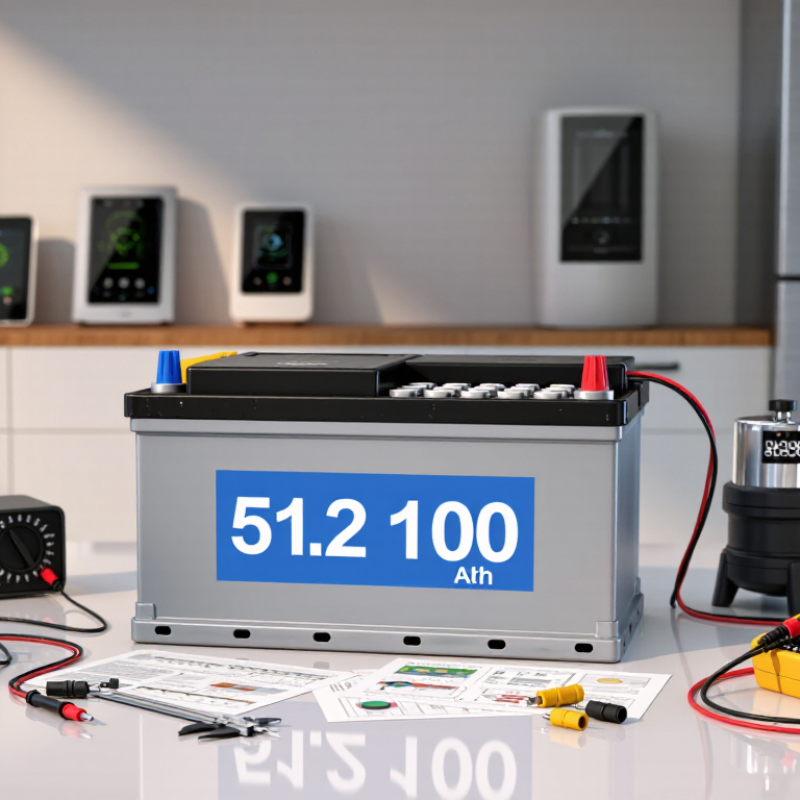
Define the Rating: 51.2 V × 100 Ah Equals 5.12 kWh Nominal Energy
A 51.2 V, 100 Ah battery has a nominal energy rating of 5.12 kWh. The calculation is simple: 51.2 volts multiplied by 100 amp-hours equals 5,120 watt-hours. That is the starting point when comparing specifications. It is not a guarantee that 5.12 kWh will reach your appliances. Usable energy can be lower because of the battery’s discharge limits, temperature, age, and the inverter’s efficiency. Small details matter.
For a practical estimate, check the manufacturer’s stated usable capacity and recommended discharge current. Then compare those figures with your loads. A 500-watt appliance running for several hours draws energy steadily, while a motor may briefly demand much more power at startup. The battery’s energy rating alone does not show whether it can handle that surge. Also check whether the 100 Ah figure applies under conditions similar to your intended use; test rates and cutoff voltages can affect measured capacity. It is tempting to treat the headline number as exact. I would leave some margin, especially for cold rooms or aging equipment. The arithmetic is firm; the real-world runtime is not.
How to Choose a 51.2V 100Ah Battery in 2026?
Define the rating: 51.2 V × 100 Ah equals 5.12 kWh of nominal energy.
At a fixed nominal voltage of 51.2 V, nominal energy is calculated as voltage multiplied by capacity in amp-hours, then divided by 1,000. Actual usable energy may be lower depending on the battery’s operating limits and system conditions.
Confirm Chemistry: 16 LiFePO₄ Cells in Series Provide 51.2 V Nominal
A 51.2V 100Ah battery is commonly built from 16 LiFePO₄ cells connected in series. Each cell contributes about 3.2V nominal, so 16 × 3.2V equals 51.2V. Series connection raises voltage; capacity remains 100Ah. That gives roughly 5.12kWh of nominal energy. A useful starting point. Still, nominal voltage is not the voltage you will see at every moment: charge level and load change the measured reading.
Check that the specification sheet confirms a 16-cell series configuration, LiFePO₄ chemistry, and a compatible battery management system. The BMS should monitor cell voltage and temperature, and provide protection against operating limits set by the manufacturer. Also compare the stated charge voltage with your inverter or charger. Small mismatches matter. BloombergNEF’s 2024 battery price survey reported an average lithium-ion pack price of $115 per kWh; this is market context, not a quote for a complete home-storage system or a guarantee of LiFePO₄ pricing.
Tips: Ask for the cell count, nominal voltage, usable energy, and BMS limits in writing. Check whether “100Ah” describes rated or usable capacity. One overlooked detail can change the fit. I would not choose by voltage alone; installation conditions and discharge limits deserve a second look.
Check Charging Limits: A 16S Pack May Charge Up to 58.4 V
A 51.2 V, 100 Ah battery often uses 16 lithium iron phosphate cells in series. Each cell has a nominal voltage of 3.2 V. At 3.65 V per cell, the pack reaches 58.4 V. That is an upper charging limit for some packs, not a universal setting.
Check the battery label and manual before choosing a charger. The manufacturer may specify a lower voltage to support longer service life. Match the charger’s voltage and current limits to the battery’s stated requirements, and confirm that its charging profile suits the cell chemistry. The battery management system provides protection, but it should not replace a compatible charger.
Small detail, big difference.
Temperature matters, too. Many lithium iron phosphate batteries should not be charged below freezing, though limits vary by model. If the charger display approaches 58.4 V, verify the reading against the battery’s specifications rather than assuming the pack needs the maximum. It is tempting to treat one number as the whole answer. It isn’t. A 100 Ah rating describes capacity, not the permitted charging current. A careful check now can prevent avoidable stress on the cells later.
Compare Usable Capacity, Cycle-Test Conditions, IEC 62619, and UN 38.3
How to Choose a 51.2V 100Ah Battery in 2026?
A 51.2V, 100Ah battery holds about 5.12 kWh nominally. That figure is only a starting point. Usable capacity depends on the battery’s reserve, discharge limits, temperature, and inverter settings. Ask for the rated usable energy, not just amp-hours. A clear datasheet should state the test conditions behind that number. A chilly garage can change the result.
Cycle life also needs context. Compare the depth of discharge, charge and discharge current, temperature, and capacity threshold used in testing. A claim of thousands of cycles means little without these details. For example, a test at moderate room temperature may not predict performance in a hot utility room. Test results are useful, but they are not a promise for every home.
Tips: Request the full cycle-test conditions and confirm the battery’s IEC 62619 documentation applies to the exact model. IEC 62619 addresses safety requirements for industrial lithium batteries; it does not tell you how much energy you can use each day. UN 38.3 covers transport testing, not cycle life or general product quality. Check that transport documents match the battery shipment. Small paperwork details are easy to miss—and I would not treat either standard as a substitute for checking capacity, protection features, and installation requirements.